




Brooklin A. Soumahoro
Let there be
Oct 13 - Dec 5, 2026
Mennour, 47 rue Saint-André-des-Arts
The opening will take place on Tuesday October 13, from 6 to 8 PM
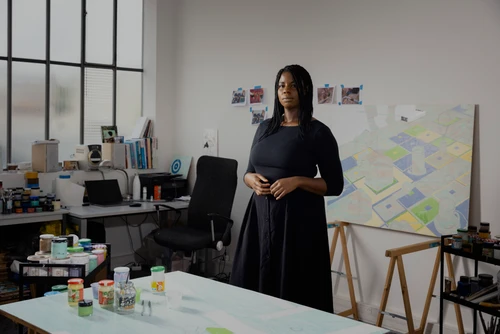
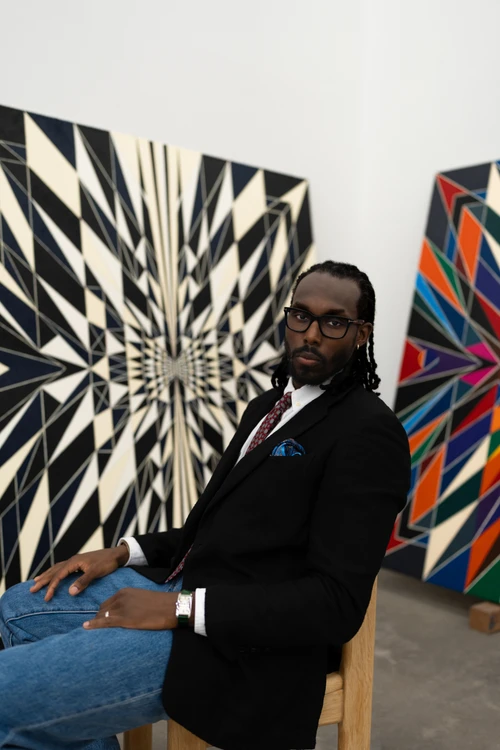
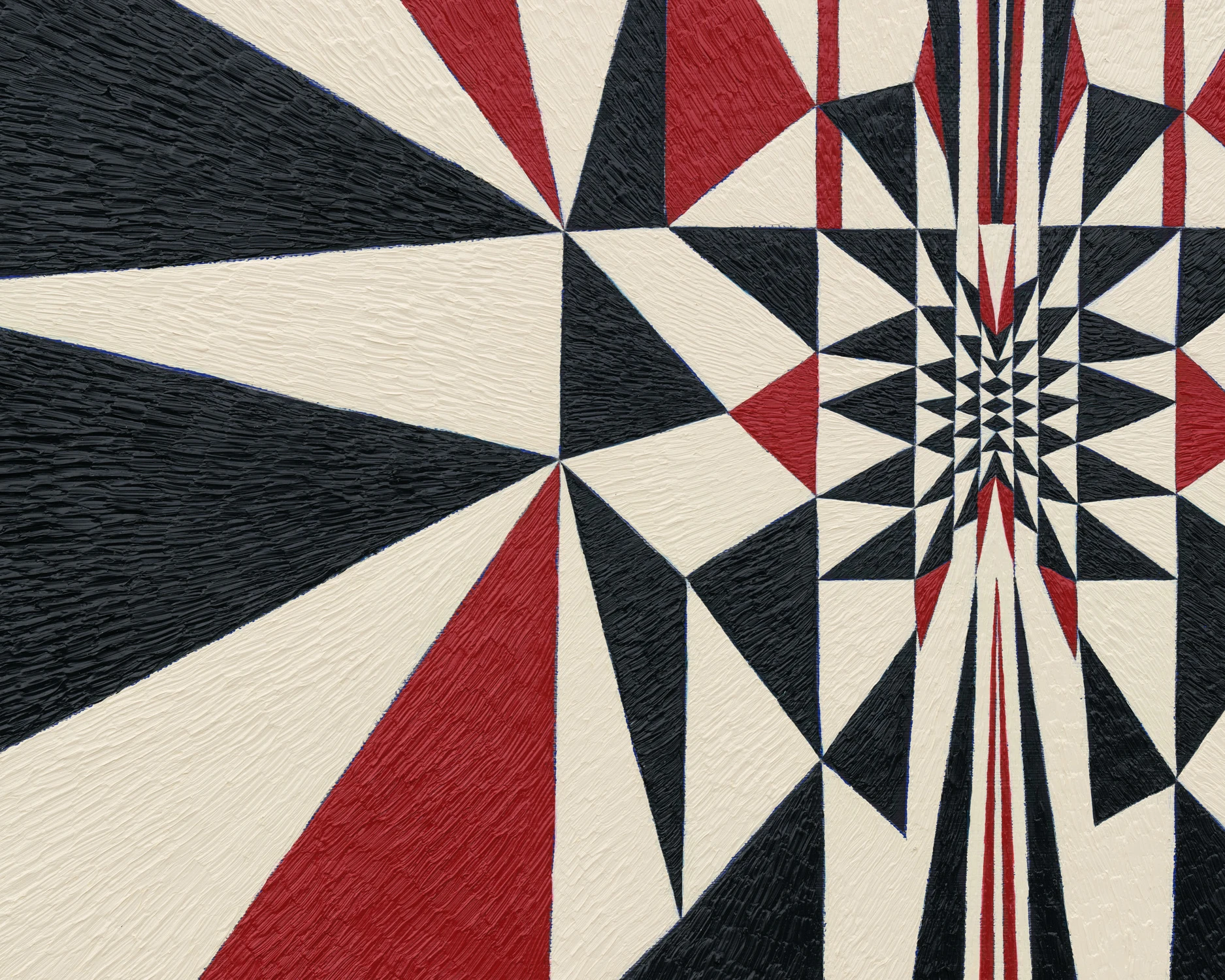
Onto what worlds do Brooklin A. Soumahoro’s Windows open? From the outset, the geometric abstractions brought together in this exhibition invite the gaze to an experience both optical and chromatic. Each canvas develops from a complex arrangement of repeated and combined triangular motifs, following a system of its own. The triangle is the elementary unit, the module from which the entire composition is built. This organisation is the result of extensive preparatory work. In pencil, Soumahoro constructs geometric structures, adjusting their proportions through precise mathematical calculations before exploring the many ways they can be combined. Yet this rigorous discipline gives rise to a state of instability that the artist calls “perfect unbalance”.
The experience of Soumahoro’s painting truly begins where the most rigorous arrangement seems to give way to instability. The gaze no longer travels across the surface but crosses a threshold and plunges into its depths. The convergence of multiple lines and the repetition of the motif expand the pictorial space, while chromatic contrasts heighten the intensity of the experience. In these paintings, the poetics of instability finds its fullest expression: colour and forms begin to move.
While, from a distance, the painting seems to obey a perfect symmetry, attention to certain details, notably very slight disruptions in the repetition of forms, reveals its irregularities. Geometry then ceases to appear as a principle of stability and becomes the instrument of a perceptual disturbance. Moreover, this painting follows a dual logic, at once centrifugal and centripetal.
While the composition seems to extend beyond its own limits, the arrangement of forms around a central point draws the gaze in the opposite direction. Space contracts and opens into depth, becoming an abyss, as though the painting were trying to free itself from the authority of the surface. This vertiginous kaleidoscope sets the painting in constant oscillation between different spatial configurations in search of a fourth dimension. It recalls the ideas of the American artists of the Park Place Gallery Group (1962–1967), who “sought in their work a cosmos modelled on Einstein’s theory”.
Soumahoro associates each colour with a musical note, transforming these compositions, with their remarkable chromatic depth, into pictorial symphonies. They bring to mind the Star Gate sequence in Stanley Kubrick’s 2001: A Space Odyssey (1968): a chromatic epiphany accompanied by the music of György Ligeti, which makes “the orchestra sparkle with iridescent colours”.
If Soumahoro’s painting plays with space, it also engages with time. Its appearance changes with the viewer’s distance, and it never reveals itself in a single glance. The full complexity of colour emerges only through an active experience that involves the movement of the gaze and the body, as well as the time spent looking. As we approach, another pictorial system emerges.
From a distance, the geometric composition stands out as a pure image; up close, its materiality gradually becomes apparent. Thousands of strokes, made with two paintbrushes measuring approximately 0.04 to 0.12 inches in width, become visible on the canvas. Painting reveals itself through the marks of its making.
Gesture does not contradict the system; it is the material condition that makes the system possible. The painting does not choose between system and gesture, image and matter, or surface and depth. It holds them in dynamic tension, and this is precisely how Soumahoro renews the legacy of geometric abstraction. Geometry no longer simply organises the composition: it produces an instability that unfolds in time and space in response to the movement of the body. Meanwhile, the materiality of the painting does not dissolve its geometric rigour. On the contrary, it intensifies its perceptual effects.
Through this distinctive coexistence of calculation and gesture, the Windows reinvent the possibilities of abstraction. They invite us to see with the whole body, revealing their full potential only through the viewer’s kinaesthetic experience. In the words of art historian Alexander Alberro, “the more the artworks act on the spectator’s nervous system, the more egalitarian they are”. Soumahoro’s Windows open onto a shared space of experience, yet its intensity remains unique to each viewer.
The exhibition title, Let There Be, thus emerges as the very programme of this painting: to allow, at the heart of the most rigorous system, the possibility of that system exceeding its own limits. It is within this powerful tension, this “perfect unbalance” — between order and disorder, rigour and perceptual blurring — that Soumahoro today resolutely shifts the coordinates of geometric abstraction.
— Marjolaine Lévy
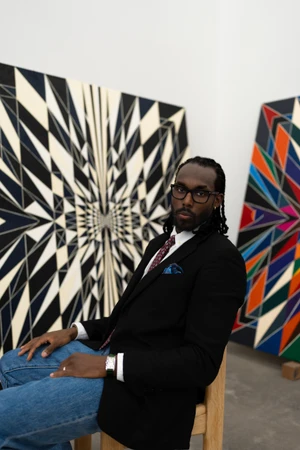
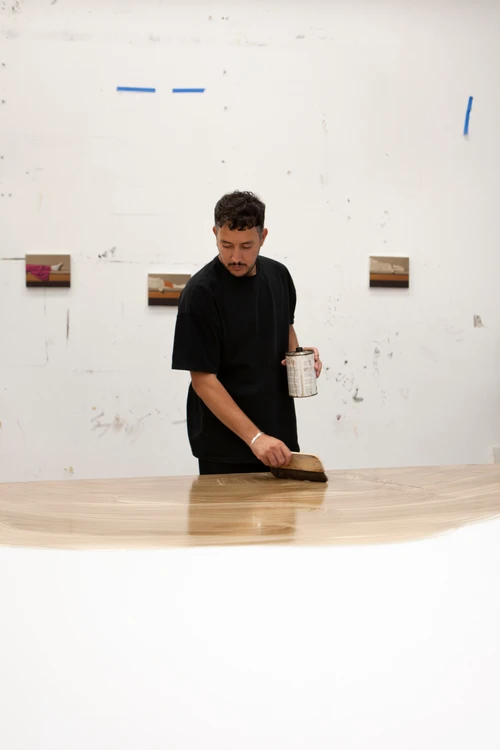
Brooklin A. Soumahoro
Born in 1990 in Paris
Lives and works in Los Angeles, United States